


Thy Deepest Distress: Anxiety and Compassion in the Christian Life
A Note to the Reader: Ten Questions
This post was written by Rev. Aaron Garriott, the managing editor of Tabletalk magazine, resident adjunct professor at Reformation Bible College in Sanford, Florida, and associate pastor of Spruce Creek Presbyterian Church in Port Orange, Florida.
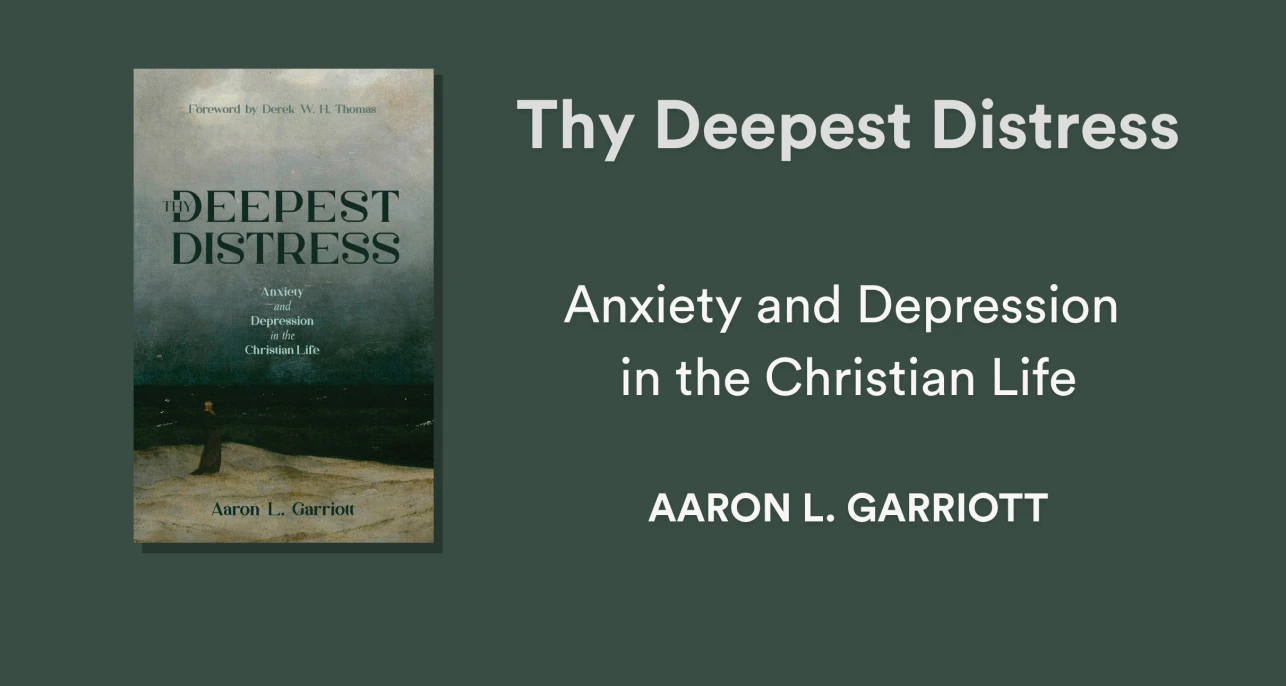
Order 'Thy Deepest Distress' here!
At the outset, I’d like to address a few preliminary matters that I hope will be helpful as we dive into this subject together. The following ten questions are intended to give the reader a clear understanding of the perspective and aim of this book.
1. Why couple anxiety with depression?
They often go hand in hand. For some, anxiety and depression might be unwelcome cousins. If you have anxiety or depression, the other might be a relative that shows up occasionally, but you don’t see him very often. For others, anxiety and depression are inseparable twins. Whenever one appears, the other is right by his side.
2. Should Christians adopt secular psychology terminology?
It depends. We shouldn’t adopt unbiblical categories, but we adopt extrabiblical terminology all the time. Some terms are better than others. Depression often goes by other names, such as melancholy, dark night of the soul, and despair. Anxiety can also mean other things. Additionally, there are different types of anxiety or anxious fears (e.g., GAD, OCD, pure O, scrupulosity, etc.). In my opinion, it matters little what we call them; while language matters, labels are merely intended to aid communication. As one of my former seminary professors put it, “We can debate the terminology, but we must acknowledge the legitimacy of mental illness. Some find it much more palatable for these issues to be either strictly medical or spiritual; however, on this side of heaven, there may not be a scalpel sharp enough to separate spiritual/psychological reasons for behavior from medical/physiological reasons for behavior. We are fearfully and wonderfully made. Our bodies respond to our minds and vice versa.” So don’t get too caught up in labels. For a helpful work on the subject, see Dr. Ed Welch’s book I Have a Psychiatric Diagnosis: What Does the Bible Say?
Thanks for reading Christian's Substack! Subscribe for free to receive new posts and suppor
3. Isn’t there a spectrum of degrees and subtypes?
Yes. When it comes to anxiety and depression, there is a wide spectrum with various “subtypes.” Because such a variety of experiences might fall under the categories of “anxiety” and “depression,” it is difficult to offer satisfactory definitions. I argue, however, that the principles given here for how to view anxiety and depression from a Christian perspective and for how to live faithfully as a Christian through anxiety and depression are helpful across the board. While I’m addressing those who have what might be considered “disorders,” I firmly believe that faithful Christians struggling with less debilitating forms of these emotions will glean some insight and, I hope, some comfort.
4. Is the author a counsellor?
No. I am a pastor, so I do biblical and pastoral counseling. I am not, however, a professional counselor at my work.
5. What about medication?
It is not my purpose here to address the topic of medications. I do not think medications for anxiety or depression are sinful. I also do not think medications for anxiety or depression are always helpful or necessary. For an evenhanded treatment of diagnoses and medications from a Christian and medical perspective, see Dr. Michael Emlet’s book Descriptions and Prescriptions: A Biblical Perspective on Psychiatric Diagnoses and Medications.
6. Is this book for Christians only?
No. But my message to non-Christians reading this is simply that before you can deal with your condition, you need to deal with your sin. Repent, therefore, and believe on the Lord Jesus Christ. While your condition may not disappear, your sin will. And that’s more important. Nevertheless, since we are body and soul, addressing the mental and physical can aid in helping us see the spiritual.
If you like what you’ve read so far, you can pre-order your copy of Aaron Garriott’s Thy Deepest Distress ahead of Tuesday’s release date (19 May 2026), at this link:
7. Why so many Puritans?
I draw often from the Puritan well because the Puritans had unique experiences of and insights into the Christian’s struggle with anxiety and melancholy. Because they can be difficult to read, however, many Christians miss out on these insights and pastoral care. I hope these nuggets will be digestible and nutritious to your soul, as they are to mine.
8. Will this book help cure my anxiety or depression?
No. This book won’t cure your anxiety disorder. At least I don’t think it will. It should, however, equip you with tools to live faithfully through debilitating anxiety. At least I pray that it will.
9. Isn’t all anxiety sin?
Not necessarily. It’s a fine needle to thread, to be sure. Anxiety that shirks responsibility or distrusts God is sinful. Some anxiety is a matter of weakness rather than moral failure. Sometimes anxiety is rooted in physical factors or the general effects of the fall. Pastorally, I do not want to call good what God calls sin. The Lord reserves severe woes to such teachers (see, e.g., Isa. 5:20). Woe to me if I fall into that error. I also do not want to call sin what God doesn’t call sin, heaping burdens on people that they cannot bear. We must let the Word of God guide our conscience, adjusting our moral compass when it is out of sync. Personally, when anxiety arises, I let it drive me to repentance. It’s better to repent when unsure. At the same time, such repentance mustn’t lead us into the pit of despair but take us to the grace of the Lord Jesus Christ, who died for all sins.
10. What is unique about this book?
There are plenty of good books on anxiety and depression, each excelling in different areas. My goal has been to create a book that combines the best of those I’ve read. I have sought with God’s help to write a work on the subject that is: (1) pastoral, (2) personal, (3) practical, (4) plain, and (5) Presbyterian. While many books do a great job in one or two of these areas, I haven’t read many that check all five. This book seeks to fill that gap.