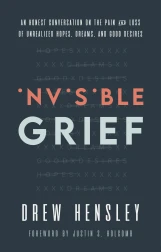
Invisible Grief
Invisible Grief: The Pain of What Never Was

I remember the day I pulled off the road near Greenlake Park in Seattle and broke down. The misting rain hit the windshield as I stared out at parents watching their kids play soccer, laughter echoing through the air. Everything around me felt alive, but inside I was dying.
I wasn’t grieving the loss of someone I loved—I was grieving what never came to be. The laughter that never filled our home. The tiny shoes never worn. The prayers that felt like they went unanswered.
For seven years, my wife, Laura, and I lived in the in-between—trying to conceive, trying to stay hopeful, trying not to crumble when hope seemed to mock us. And the hardest part? Our grief was invisible. No funeral, no casseroles, no socially acceptable timeline for healing. Just the quiet ache of absence and the awkward silence of friends who didn’t know what to say.
If you’ve ever carried that kind of ache, you know exactly what I mean.
Invisible grief is the sorrow that comes from what’s never been—and may never be. It’s the loss of good and godly desires that go unmet. It’s the death of dreams that never made it into reality. It’s infertility, singleness for those who long to be married, mental or physical limitations, chronic illness, broken family ties—the list is long. It’s the pain of prayers that feel like they’ve vanished into the ceiling and the confusion of wondering why God hasn’t shown up the way you expected.
I wrote Invisible Grief because I realized I wasn’t alone—and neither are you.
We Don’t Know How to Grieve What We Never Had
When someone dies, we have rituals. We bring flowers, share stories, gather around tables, and remember. But what about when there’s nothing tangible to bury? When there are no pictures to hold, no memories to revisit, no proof that what we hoped for was even real?
That’s where invisible grief hides—in the empty spaces, in the things that never happened but should have.
For a long time, I tried to out-run it. I threw myself into ministry, busyness, distractions—I numbed myself with alcohol, anything that could keep me from sitting still with the pain. I was desperate for a break from the noise in my head that whispered, God’s forgotten you.
But here’s what I learned the hard way: you can’t out-run what lives inside you.
Grief has to be faced to be healed. It has to be named to be redeemed. And it has to be shared to be carried.
This Kind of Grief Is Everywhere
As I’ve walked out my own grief, I’ve had the opportunity to walk alongside many others in the same boat.
Overt the years my inbox and phone have filled with messages from pastors, teachers, parents, and individuals—each with their own version of invisible grief. One woman wrote, “My husband and I lost our fifth round of IVF last month. We haven’t told anyone. It helps just to know someone else understands.”
A pastor wrote, “I buried my calling years ago when ministry fell apart. I can’t even name it as grief, but that’s exactly what it is.”
The more I’ve listened, the more I’ve realized: this kind of grief is everywhere. It fills our churches, our neighborhoods, our homes, our places of work and play.
Every single one of us walks through loss that doesn’t fit neatly into a category. Every one of us carries disappointments we’ve been told to just “get over.” But grief doesn’t work like that—especially the kind that no one else can see.
And it’s into that silence—into those unanswered aches—that the gospel speaks.
The Gospel Doesn’t Skip Over Our Sorrow
The heart of Invisible Grief isn’t just empathy—it’s hope. Real hope. Not the cheap kind that comes packaged in Christian clichés, but the kind that’s born in the dark and still refuses to die.
The gospel doesn’t offer us a quick fix or a five-step plan. It offers us a Savior who knows what it means to lose. A Savior who weeps at graves, who laments, who carries scars even in resurrection.
The beauty of the gospel is not that Jesus erases our pain—it’s that He joins us in it. He sits beside us in the silence, holds our sorrow without flinching, and gently reminds us, Your grief is not wasted.
Why I Wrote This Book
I didn’t set out to write another book about grief. I set out to give language to the kind of pain most people don’t know how to name. I wanted to write the book Laura and I needed years ago when we were sitting in doctor’s offices and silent bedrooms wondering if God still saw us.
This book isn’t about giving answers. It’s about telling the truth—and finding God in it.
It’s about learning that faith and doubt can coexist, that lament is a form of worship, and that there’s healing found not in pretending to be okay but in admitting that we’re not.
You’re Not Alone
Maybe you’re grieving a dream that never materialized. Maybe it’s a relationship that never healed, a future that feels forever out of reach, or prayers that feel like they’ve gone unanswered. Whatever it is, you’re not crazy, weak, or faithless for feeling the ache. You’re human.
And more than that—you’re loved.
God sees you in the silence. He’s not ashamed of your questions or put off by your tears. He’s not waiting for you to pull yourself together. He’s sitting beside you, whispering what I believe are some of the most comforting words in Scripture: “The Lord is near to the brokenhearted and saves the crushed in spirit.” (Psalm 34:18)
If that’s you, I want you to know: you don’t have to walk through it alone.
If that’s someone you know, learn how to walk alongside and support them.
This book is an honest conversation about pain and loss, but more than that—it’s a reminder that even when life doesn’t go the way we hoped, there’s still a God who is faithful, present, and good.
Because while grief might be invisible, hope never is.