


A Student's Guide to the Good Life
Everyone wants to live a good life, because no one wants to reach the end of life only to realise that they’ve wasted it.
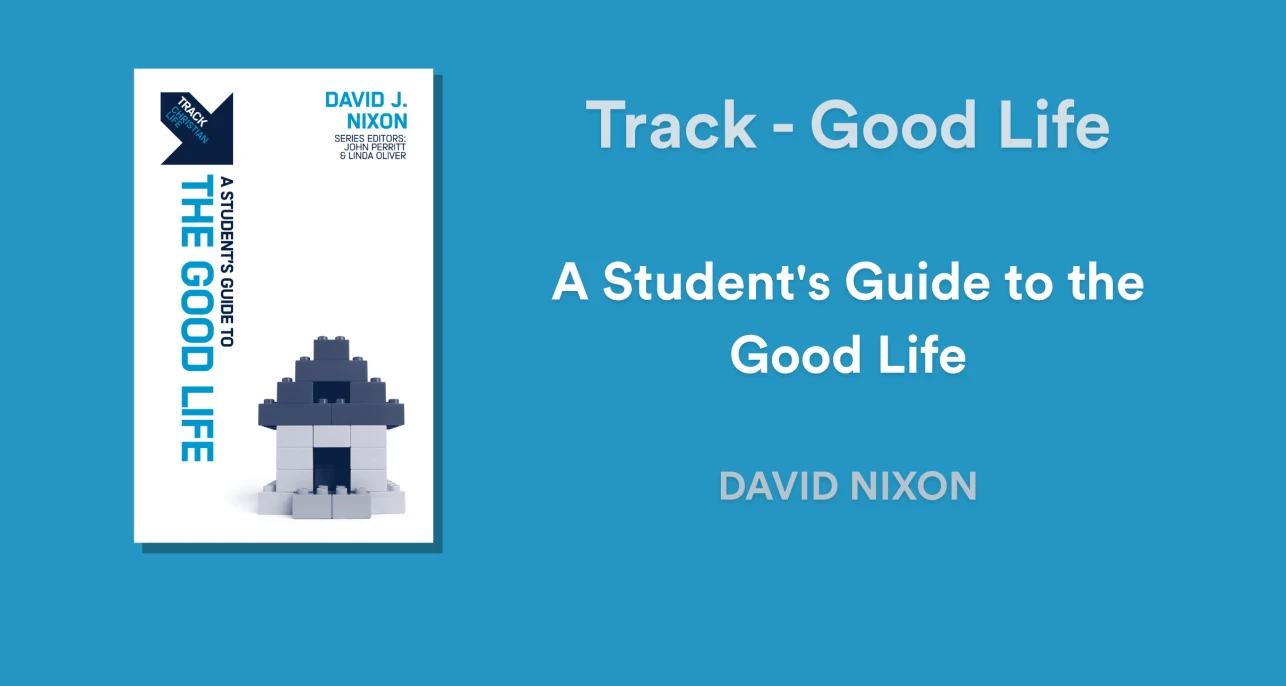
This post was written by David J. Nixon, the pastor at Carrubbers church in the heart of Edinburgh and author of one of the newest volumes in our ‘Track’ series, A Student’s Guide To Good Life.
Everyone wants to live a good life, because no one wants to reach the end of life only to realise that they’ve wasted it.
In that sense, we’re all like a central character in Stephen Spielberg’s blockbuster movie Saving Private Ryan. Loosely based on true events, it tells the story of a team of soldiers sent on a mission to rescue the young private James Ryan – the one brother, out of five, to survive the Normandy D-Day landings.
The film opens and closes with the scene of elderly James Ryan hobbling into a Normandy cemetery, accompanied by his family. Stretched out before them, as far as the eye could see, were thousands of white crosses planted in a sea of green grass. Each cross marked the grave of a fallen soldier who had sacrificed their life to save others. Standing before one gravestone, he fell down on his knees and broke out in tears. His family rushed to his side, but there was only one thing that could bring him any comfort. He sought the reassurance: “Tell me I’ve lived a good life. Tell me I’m a good man.”
Like James Ryan, we all want to live a good life. However, there are many competing stories of the good life circulating around the world.
If we listen to the ancients, Plato says, “Get wisdom”; Aristotle says, “Get virtue”; Epicurus says, “Get happiness”; or Zeno says, “Get stoical.”
If we listen to the moderns, the celebrities say, “Get rich and famous”; the playboys say, “Get laid”; the eco-friendly say, “Go vegan”; or the gym-lifers say, “Get fit.”
The book shops are filled with shelves of books on different lifestyle packages; the podcast charts are dominated by the likes of Joe Rogan with his rotating cast of guests discussing alternative lifestyles; the social media platforms are bursting with the life hacks and advice from influencers.
Faced with this smorgasbord of options, how can we know which version of the good life to choose?
The philosopher Alasdair MacIntyre famously quipped that we cannot answer the question, “What am I to do?”, without first understanding the question, “What story do I find myself a part?” The decision to kiss or kill the monster depends on whether you’re starring in Disney’s Beauty and the Beast or Ridley Scott’s Alien.
If you’re a Christian, then you are not the author of your own story. God is creator of this world, the giver of life and the author of our stories. Therefore, the good life involves finding our place in God’s story. The Bible tells us that the good life involves God’s life being shared with us (John 17:3) and God’s love being shared through us (John 13:34-35) – in union with God’s Son, Jesus Christ.
For generations, Christians have looked to the Ten Commandments as God’s blueprint for the Good Life in God’s Story.
When we look at Exodus 19-20 we find this story: by His grace God has saved His people from the land of slavery and He is leading them to the promised land of blessing. On that journey God gave them the Ten Commandments. They serve three good purposes:
· They reveal our sin and need of Jesus the saviour
· They restrain sin in society
· They reveal God’s design for the good life which reflects His own good character
If the Ten Commandments are the blueprints for the good life, then Jesus is the finished product. In Jesus we see God’s perfectly obedient Son, living life as God intended it to be.
Nevertheless, Christianity cannot be reduced to the slogan, WWJD? (What Would Jesus Do?). Imagine starting off on a long journey by unlocking the car, releasing the handbrake and pushing it along yourself. That would be ridiculous, but it’s akin to reducing Jesus to a role model or moral example whom we should strive to imitate.
Unfortunately, it’s a widespread mistake. For example, in recent years, Jordan Peterson has become a guru on the global stage. His lectures are consumed by millions and his books are best sellers. His essential message is reflected in the titles of his books – the first entitled 12 Rules for Life, and the second subtitled 12 More Rules for Life. If the sickness of the modern life is narcissism and meaninglessness, then Peterson’s prescription for the good life is personal responsibility. Get up in the morning, make your bed, stand up straight, and go out into the world to labour for the common good. Don’t waste your life pursuing personal happiness; instead, pour out your life in voluntary sacrifice for others. That is the long, hard path up the mountain which leads to divine meaning and human satisfaction.
It’s true that Peterson’s work contains many pearls of wisdom and often alludes to the Bible and Jesus. However, Peterson is not yet a Christian and he misunderstands the gospel. The Bible makes clear that the good life requires more than good advice and good role models – it can only be lived by the grace and power of God. It is not a life of self-powered imitation, but a life of Spirit-empowered participation in the life of God in union with Christ.
In short, we need more than a law-giver who announces from atop the mountain, “Ten Rules for Life.” We need a life-saver and a new life-giver because we’re all law-breakers. Ten rules cannot save us, but one person can: Jesus Christ! Jesus is the God who has come down the mountain in order to save us from ourselves and lift us up to share in His life.