


You're Not in Control: It’s Good to Need Help
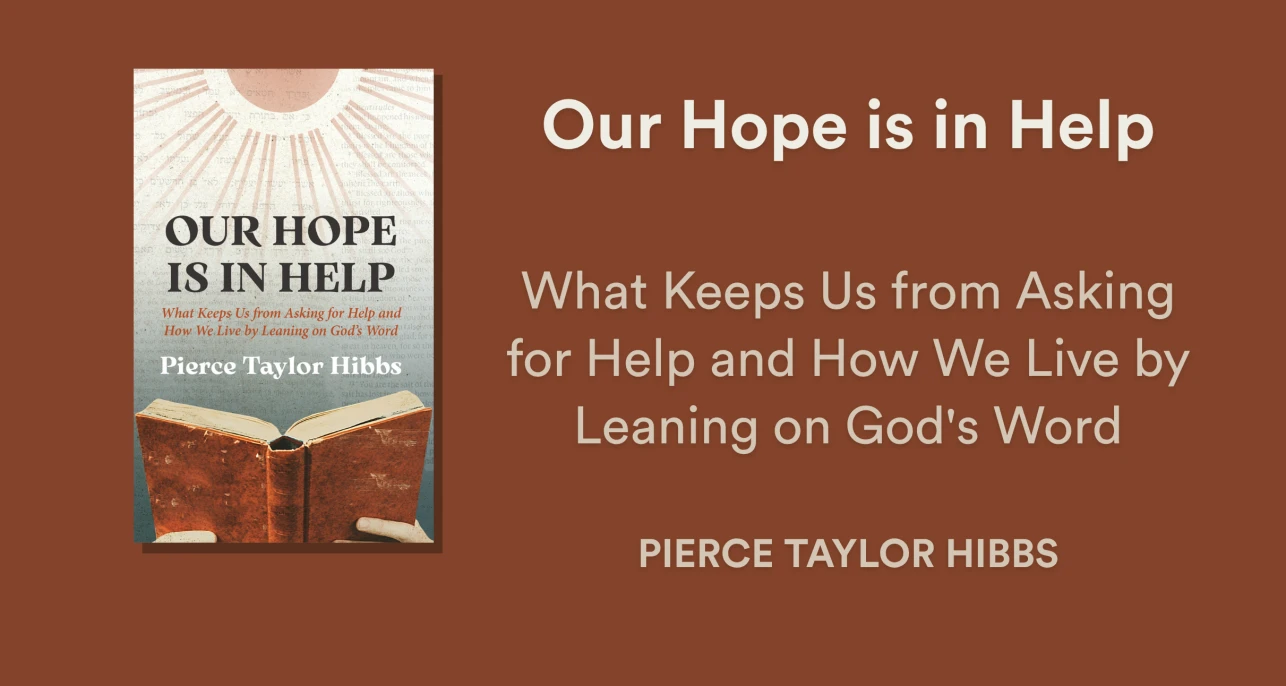
This post was written by Pierce Taylor Hibbs, the author of one of our releases, Our Hope is in Help. If you enjoy what you read, you can get your copy today:
Here’s a hot take on life: you’re not in control. Not exactly encouraging, is it? That’s because we treat control as a virtue. We believe it is good to manage our lives. It is good to rule over our circumstances. It is good to be independent. There’s some truth to that, but only a little bit. In fact, the sociologist Hartmut Rosa says our rampant desire for control in the modern West is tearing us apart from the inside out. In The Uncontrollability of the World, he writes,
The driving cultural force of that form of life we call “modern” is the idea, the hope and desire, that we can make the world controllable. Yet it is only in encountering the uncontrollable that we really experience the world. Only then do we feel touched, moved, alive. A world that is fully known, in which everything has been planned and mastered, would be a dead world (p. 2).
For Rosa, our desire for control means everything we encounter must be “known, mastered, conquered, made useful” (p. 6). This desire permeates our lives so deeply that we can’t see it. Yet it gives rise to our anxiety, frustration, isolation, and detachment. And its roots go far beyond the modern West; they go back to the ancient world of Genesis 3.
Autonomy
Theologians would label this rampant desire for control as “autonomy”—the will to govern ourselves. And that is precisely what happened in the Garden of Eden. In my book Our Hope Is in Help, I rephrase it as a couplet:
I’m fine on my own—no divine assistance.
Heart set like a stone, hardened in resistance.
That was the posture of Adam and Eve’s spirit when they ate the forbidden fruit. God’s Word had been given to help them, so that they might lean on it and find life. And yet they rejected that help. They wanted to go their own way. They wanted to control their destiny. Hartmut Rosa’s book is a contemporary essay on an ancient evil. The more we reject God’s help and go our own way, the closer we come to our own destruction.
In Scripture, God’s help comes primarily through his Word, his speech. God, in fact, created us to respond to his Word, even before sin entered the picture. God spoke to Adam and Eve in the garden and gave them purpose and guidance (Gen. 1:28–30; 2:15–17). They were meant to lean on that, to find joy in divine help. When they turned away from God, the specter of autonomy clung to them and to all their progeny. It was a disease of self-determination.
As Scripture unfolds, it offers a sort of “anatomy” for autonomy, how it works out in our own lives. This anatomy isn’t always linear and logical, but it may help to describe it that way. It starts with moral or ethical blindness. We choose not to see what God has revealed as good and right. Adam and Eve did this in blinding themselves to the goodness of God’s Word. In the New Testament, Jesus critiques the Pharisees of doing precisely this (Matt. 23:16–17). The Pharisees blind themselves to heart-level worship and devotion to the truth, especially as embodied in God’s own Son standing in front of them. Then autonomy brings reductionism. We simplify the situation, especially by blocking God out, reducing him from the circumstances. Adam and Eve do this in Genesis 3 by treating God as a third-party outsider when they decide to break his command (Gen. 3:6–7). From reductionism, we move to control and mastery. David is a classic example in his adultery with Bathsheba (2 Sam. 11). He moves Bathsheba and Uriah around as if there were pawns on his chess board. It’s humiliating and selfish. The final stage of autonomy is idolatry, often idolatry of the self. We worship ourselves as the center of the universe. All else must revolve around our wishes and expectations and desires. David’s adultery, again, is the epitome of this. All people, circumstances, and relationships revolve around him. And that becomes his undoing, as the prophet Nathan reveals (2 Sam. 12:1–15).
With every phase of autonomy, we move further from God. This shows, once again, that the more we reject God’s help and go our own way, the closer we come to our own destruction.
An Example: Rebekah
Consider a less common example in Scripture and what we might learn from it: Rebekah and her trickery in stealing Isaac’s blessing for her favored son, Jacob (Gen. 27). During her pregnancy, God had revealed to Rebekah that her younger son would rule over the elder: “Two nations are in your womb, and two peoples from within you will be separated; one people will be stronger than the other, and the older will serve the younger” (Gen. 25:23). In Genesis 27, Rebekah seizes an opportunity, and autonomy rears its ugly head.
First, Rebekah willingly blinds herself to the truth of God: that lying is sinful and harms others. The sinfulness of lying comes out explicitly in the Ten Commandments, but it’s clearly implied in Genesis 18:15, when Sarah denies laughing at God’s promise. Then, Rebekah reduces the situation by blocking God out of the picture. In those times, it was customary for the elder son to receive a blessing and rule over the younger siblings. Could God work around that somehow to bless Jacob? Of course, but Rebekah didn’t want to risk it. She blocks out God’s providence and takes the reins of the situation: she will help Jacob steal Esau’s blessing. The control and mastery come in when she covers her son in newly slaughtered lambs’ hide. Think of how much effort went into mastering Isaac in his bestowal of blessing. The poor blind man is duped and plays into their hands. Lastly, we see idolatry of self come in when Rebekah substitutes her own voice for the voice of God. Several times she tells Jacob, “Obey my voice” (27:8, 13, 43). This is the exact language God uses when directing his creatures, and his voice alone is sovereign (Gen. 22:18; 26:5). That’s why he first judges Adam: “Because you have listened to the voice of your wife . . .” Scripture is a war of voices. Whenever someone puts their own voice in place of God’s, you have idolatry of self.
If you like what you’ve read so far, you can order your copy of Pierce Taylor Hibbs’ Our Hope is in Help, at this link:
Application
What does the story of Rebekah teach us? How does this Word of God give us help? The story of Rebekah helping her son steal Isaac’s blessing offers both warnings and encouragement.
First, it warns us that even when we know what God wants for our lives—as Rebekah knew what God wanted for Jacob—that doesn’t mean we know how to bring it about. There are sinful ways of doing the right thing. Our means matter, not just the ends. Each day, we are confronted with many opportunities to do what is right in the wrong way. For instance, I might have the aim of being efficient and on-task in a work meeting, knowing that time is limited and valuable. But if I decide to cut other people off mid-sentence in order to shut down the dialogue and end the meeting, that’s not okay. It doesn’t matter that my goals were on target. My means were sinful, and they reflect my desire to control a situation that, frankly, is well beyond me.
Second, Genesis 27 encourages us by showing that even when our motives or means are corrupt, God often shows mercy and grace in using us anyway. God used Rebekah and Jacob in the bringing about of his Word from Genesis 25:23, even though they acted sinfully. That doesn’t mean God is okay with sin. It just means that, in remarkable ways, God uses us despite our failings. He makes a path for his Word to go forward. Ultimately, he does that through giving his own Son to do what we could not and would not do. God saves us despite ourselves.
When I’m confronted with a challenge, I can rehearse the warning and encouragement from Genesis 27, instead of trying to “go it alone.” I can pray that God would clarify the means he wants me to take to his revealed end. I can also trust in Christ to believe that God will use me despite my failings and missteps.
Scripture is full of these examples because Scripture is our primary help as limited creatures. In his Word, God shows us that it is good for us to need help. He designed us to lean on his instruction in every situation. Part of Christian maturity is trusting God to do what he wills despite all appearances that might encourage us to act autonomously. God makes his own way, and he brings us along with him.
Remember today that it is good to need help. It is good to lean on the words of an unshakable God. The more we do that, the closer we grow in fellowship with him and with his people.